






































































































































































Table of Contents
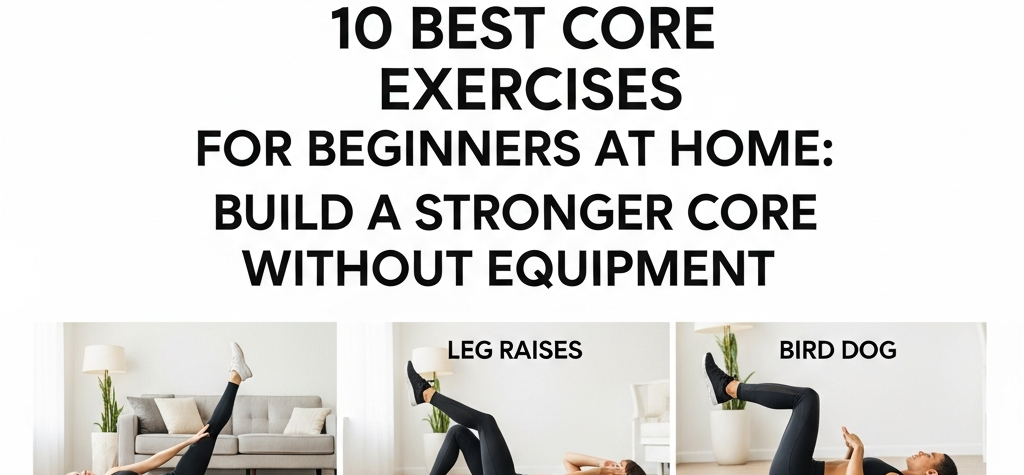
Toggle10 Best Core Exercises for Beginners at Home: Build a Stronger Core Without Equipment
Author: RVLNSV PRASAD
Updated On: October 2026
About Us
Author Bio
Editorial Policy
Contact Us
Introduction
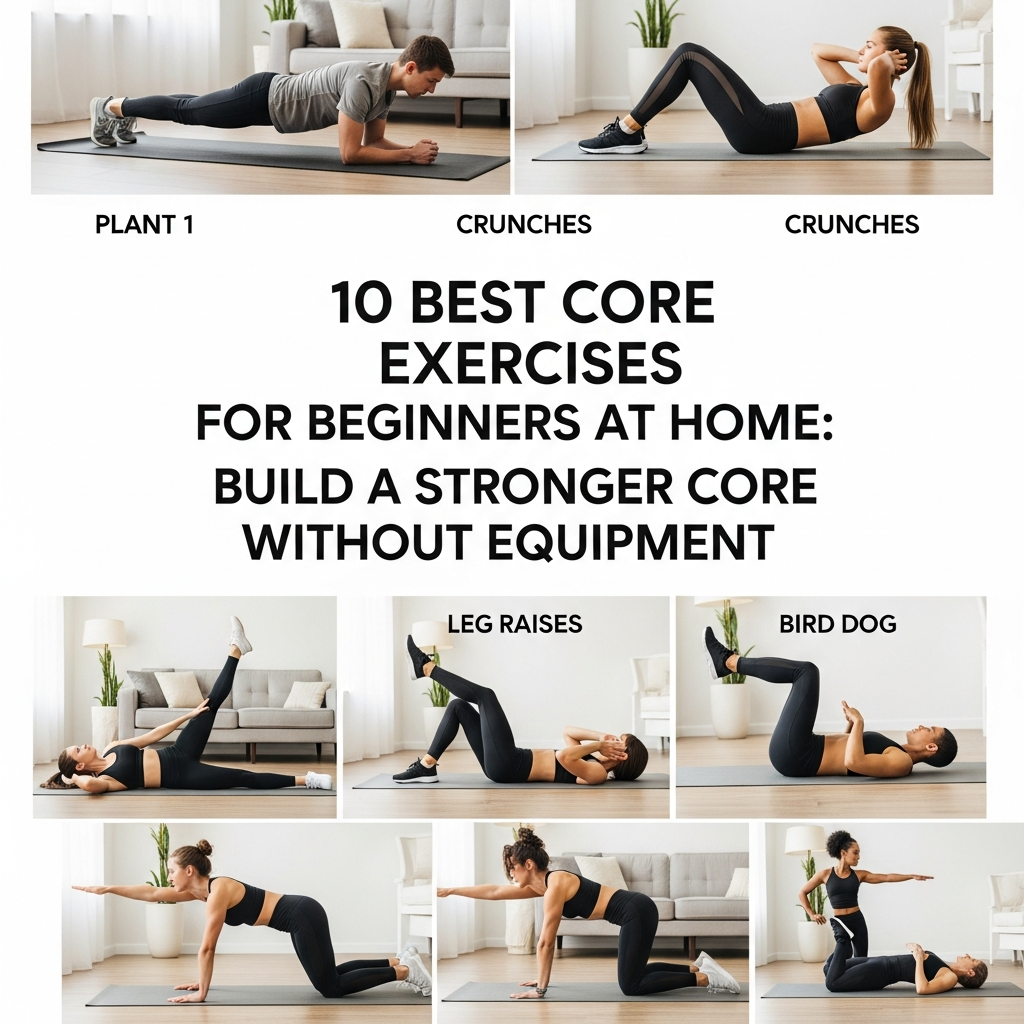
Your core helps you sit upright, turn your body, reach for objects, and maintain balance while moving. Yet many beginners assume that building a stronger core requires difficult sit-ups, long planks, or expensive gym equipment. In reality, a few carefully selected movements can provide a practical starting point at home.
The best beginner core exercises at home without equipment are not necessarily the hardest ones. They are movements you can perform with control, repeat consistently, and adapt as your strength improves. Exercises such as pelvic tilts, dead bugs, bird dogs, modified planks, and glute bridges train different parts of the trunk and surrounding muscles.
You also do not need to perform hundreds of repetitions to make progress. Learning how to breathe, maintain a comfortable body position, and control each movement can be more useful than rushing through a long routine.
This guide explains how your core works, which exercises beginners can try, how to combine them into a simple workout, and how to progress without making every session harder. It also covers common mistakes, realistic expectations, and safety considerations.
Quick Answer: What Are the Best Core Exercises for Beginners at Home?
Ten useful exercises to consider are standing marches, seated knee lifts, pelvic tilts, heel slides, dead bugs, bird dogs, modified planks, glute bridges, side-lying leg raises, and seated torso holds.
Start with four or five exercises rather than trying to master all ten in one session. Perform one comfortable set of each, rest as needed, and focus on controlled movement. As the exercises become easier, gradually increase repetitions or holding time.
The Mayo Clinic’s core-strength guidance also emphasizes controlled technique, breathing, and exercises that work the abdominal muscles, back, and pelvis.
If you have persistent back pain, a recent injury, osteoporosis, or another condition that affects exercise, ask a qualified healthcare professional which movements are suitable for you.
Key Takeaways
- Your core includes abdominal, back, pelvic, and other muscles that help control your trunk.
- Beginners can build a routine using body weight and a small amount of floor space.
- Slow, controlled movements are generally more useful than rushing through repetitions.
- A balanced routine should include more than abdominal exercises alone.
- Start with a manageable number of exercises and increase the challenge gradually.
- Core training may help improve strength and movement control, but it does not guarantee pain prevention or treatment.
- Rest, appropriate technique, and consistency matter more than performing a workout every day.
What Is the Core, and Why Does It Matter?
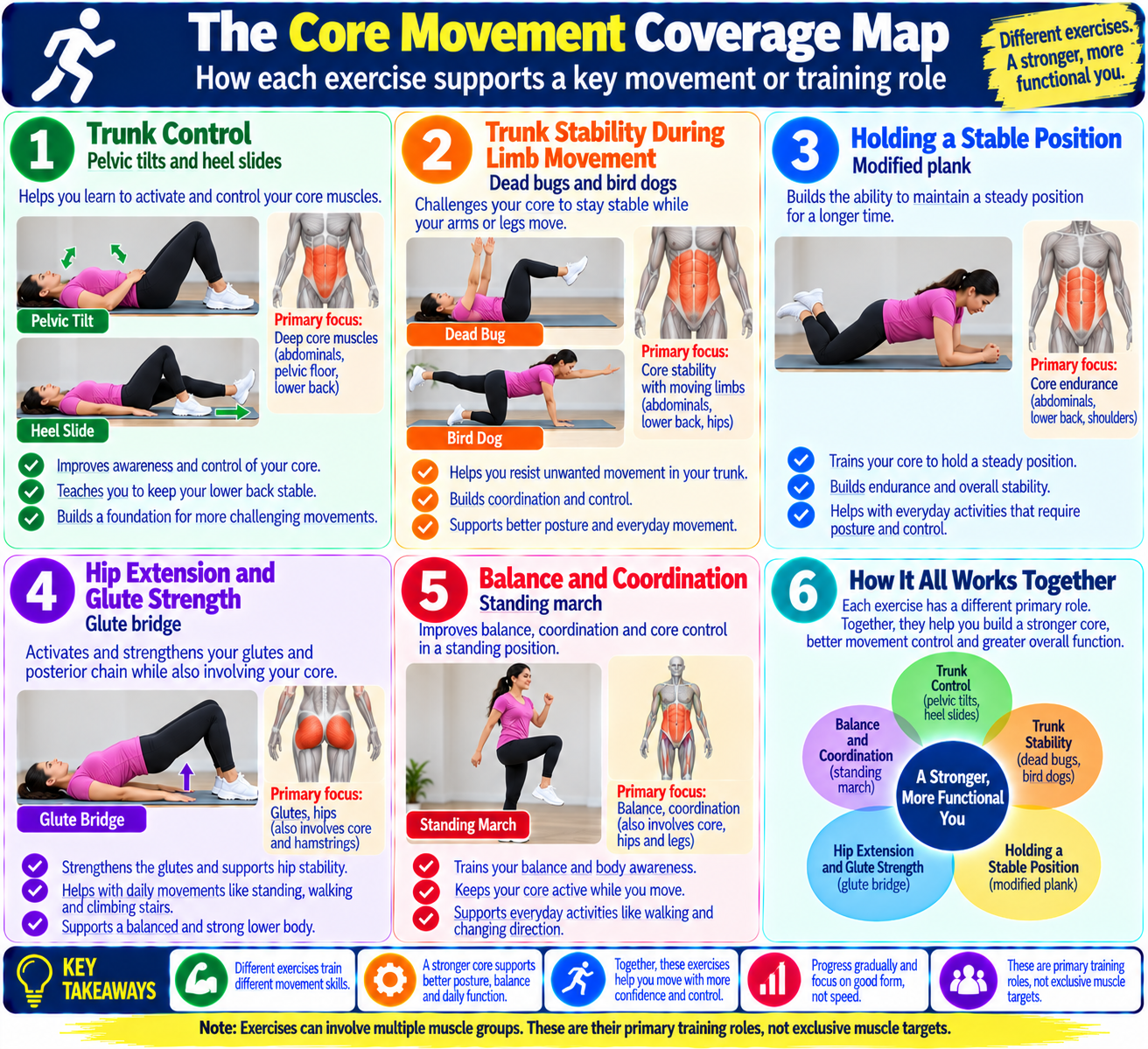
Your core is a group of muscles that help support and control your trunk. It includes the abdominal muscles, muscles around the spine, and muscles that contribute to pelvic and trunk stability.
These muscles work together during ordinary activities such as getting out of a chair, carrying groceries, reaching overhead, and changing direction while walking. A stronger, better-coordinated trunk can make these movements easier to control.
However, the core is not a single muscle, and no one exercise trains every part equally. A plank challenges your ability to hold a stable position, while a bird dog adds a balance and coordination challenge. A glute bridge also trains the hips and buttocks, which contribute to movement and support.
The Mayo Clinic explains how core exercises involve the abdominal muscles, back muscles, and muscles around the pelvis. That is why a balanced beginner program should include different movement patterns instead of focusing exclusively on sit-ups.
Core strength is not the same as visible abs.
Visible abdominal muscles depend on several factors, including body composition, genetics, and overall training. Performing core exercises can strengthen the muscles, but it does not guarantee a visible six-pack or remove fat from a particular area.
For beginners, more useful goals include improved movement control, the ability to maintain a comfortable exercise position, and gradually increasing the difficulty of a routine.
What Does Research Say About Core Training?
Research supports core training as one approach to improving trunk strength and movement function. The effects depend on the exercise program, the person doing it, and the outcome being measured.
A systematic review published in 2022 examined core-stability exercises for adults with nonspecific low-back pain. Five moderate-quality studies supported improvements in pain, function, and core strength. The review was relatively small, so its findings should not be interpreted as proof that every core routine treats every type of back pain. Read the full systematic review on PubMed.
A separate systematic review and meta-analysis, published in 2022, examined core training and dynamic balance. It reported a moderate overall effect across the included studies, although the studies involved relatively small participant numbers. Explore the research on core training and dynamic balance.
More recent research continues to examine which types of core exercise may be most useful for people with chronic nonspecific low-back pain. A 2025 systematic review and meta-analysis comparing Pilates, core-stability training, and core-resistance training found improvements across the included approaches, but comparative effectiveness varied by outcome. See the 2025 review on PubMed.
What does this mean for beginners? Core exercises can be a valuable part of a general fitness program. However, research on people receiving treatment for back pain should not be treated as proof that a home routine will prevent pain or cure an existing condition. Exercise selection should reflect your goals and physical abilities.
10 Best Beginner Core Exercises at Home Without Equipment
You can perform the following movements using a clear floor area. A comfortable exercise mat is optional, although a folded towel may make kneeling or lying exercises more comfortable.
1. Standing March
Standing marches provide a simple way to practise trunk control while moving your legs. They are particularly useful if you prefer to begin with an upright exercise.
How to do it
- Stand with your feet about hip-width apart.
- Keep your chest comfortable and your shoulders relaxed.
- Lift one knee, lower it, and alternate sides.
- Continue at a steady pace while breathing normally.
Beginner tip: Start slowly and avoid leaning backward as you lift your knees. If balance is difficult, perform the movement beside a stable support.
Why it helps: Marching challenges balance and coordination while encouraging you to maintain an upright position. It is a useful preparation exercise, although it does not replace more direct trunk-strengthening movements.
2. Seated Knee Lifts
Seated knee lifts allow you to practice controlling your legs while sitting. They can be a useful alternative for people who find getting onto the floor difficult, provided the movement is comfortable for them.
How to do it
- Sit toward the front of a stable chair with both feet on the floor.
- Sit comfortably upright without forcing your back into an exaggerated arch.
- Lift one foot a short distance from the floor.
- Lower it slowly and repeat with the other leg.
Beginner tip: Keep the movement small enough that you can remain steady. Use your hands on the chair if you need additional support.
Why it helps: The exercise challenges posture and coordination while the legs move. The amount of abdominal work varies with the movement and the person’s technique, so avoid promising that it specifically burns lower-abdominal fat.
3. Pelvic Tilt
Pelvic tilts help beginners practice gentle control of the pelvis and lower trunk. They are often used in exercise programs to introduce awareness of pelvic movement.
How to do it
- Lie on your back with your knees bent and feet flat.
- Allow your back to rest in a comfortable position.
- Gently tighten your abdominal muscles and tilt your pelvis so your lower back moves closer to the floor.
- Hold briefly while breathing normally, then relax.
Beginner tip: Use a small, comfortable movement. Do not force your back downward or hold your breath.
Why it helps: Pelvic tilts teach you to control the position of your pelvis. They are a useful introductory movement, but they should not be described as a guaranteed treatment for back pain.
4. Heel Slides
Heel slides introduce leg movement while you practice keeping your trunk controlled. They are a useful stepping stone before attempting more demanding exercises such as the dead bug.
How to do it
- Lie on your back with both knees bent and feet flat.
- Gently engage your abdominal muscles.
- Slowly slide one heel away from your body until your leg is more extended.
- Slide it back to the starting position and alternate sides.
Beginner tip: Move only as far as you can while keeping your pelvis comfortable and controlled. Shorten the slide if your back begins to arch excessively.
Why it helps: Heel slides teach coordination between the legs and trunk. They also let you practice controlling a movement without lifting both legs off the floor.
5. Dead Bug
The dead bug is a popular core exercise because it challenges you to move your arms and legs while controlling your trunk. It can be made easier by moving only one limb at a time.
How to do it
- Lie on your back and raise your arms toward the ceiling.
- Lift your legs so your hips and knees are bent, if comfortable.
- Gently engage your abdominal muscles.
- Slowly lower one arm or one leg while keeping your trunk controlled.
- Return to the starting position and repeat on the opposite side.
Beginner tip: Start by moving one leg at a time. Progress to the opposite arm and leg only when you can maintain control without straining.
Why it helps: The dead bug trains trunk stability during limb movement. The Mayo Clinic’s core-strength guidance offers related core-control exercises and emphasizes maintaining proper technique.
6. Bird Dog
The bird dog challenges trunk stability, coordination, and balance. It is performed on your hands and knees, so make sure the surface is comfortable.
How to do it
- Start on your hands and knees.
- Place your hands below your shoulders and your knees below your hips.
- Keep your back in a comfortable, neutral position.
- Extend one leg behind you without twisting your trunk.
- Return to the starting position and switch sides.
When this feels manageable, extend the opposite arm and leg together.
Beginner tip: If raising a leg causes you to twist or lose balance, start by lifting only one arm or moving one leg a short distance.
Why it helps: Bird dogs challenge your ability to keep the trunk steady while the limbs move. They also require coordination, making them a useful addition to a balanced beginner routine.
7. Modified Plank
A modified plank challenges your abdominal and trunk muscles while reducing the demand of a full plank performed on the toes.
How to do it
- Lie face down and position your forearms on the floor.
- Place your knees on the floor.
- Lift your trunk so your shoulders, hips, and knees form a comfortable line.
- Keep breathing and hold briefly.
- Lower yourself carefully.
Beginner tip: Start with a hold of five to ten seconds if that is manageable. Stop before your hips sag or your shoulders become uncomfortable.
Why it helps: The modified plank trains your ability to maintain a stable position. The Mayo Clinic’s modified-plank instructions provide an additional reference for technique.
8. Glute Bridge
The glute bridge strengthens the buttocks and challenges control around the hips and trunk. It is not exclusively an abdominal exercise, but it complements a core routine.
How to do it
- Lie on your back with your knees bent and feet flat.
- Position your feet comfortably apart.
- Gently tighten your abdominal muscles and buttocks.
- Lift your hips until your body forms a comfortable line from your shoulders toward your knees.
- Lower slowly.
Beginner tip: Lift only as high as you can without arching your lower back. A smaller, controlled lift is better than forcing the hips upward.
Why it helps: The bridge trains the gluteal muscles and hip extension while requiring trunk control. The Mayo Clinic describes the bridge as a core-strength exercise.
9. Side-Lying Leg Raises
Side-lying leg raises primarily train the muscles around the hip, including the outer hip muscles. They also challenge your ability to maintain a stable side-lying position.
How to do it
- Lie on one side with your legs comfortably extended.
- Support your head with your arm if needed.
- Keep your hips stacked rather than rolling backward.
- Lift the upper leg a short distance.
- Lower it slowly and repeat before switching sides.
Beginner tip: Keep the movement small and controlled. Avoid swinging your leg or rotating your pelvis to gain height.
Why it helps: Strong hip muscles contribute to movement and pelvic control. This exercise complements direct abdominal exercises rather than replacing them.
10. Seated Torso Hold
A seated torso hold introduces the idea of maintaining a controlled trunk position. It should remain comfortable rather than becoming a test of how far backward you can lean.
How to do it
- Sit on the floor with your knees bent and feet resting on the floor.
- Sit upright and gently engage your abdominal muscles.
- If comfortable, lean backward a small amount while keeping your back controlled.
- Hold briefly while breathing normally.
- Return to an upright position.
Beginner tip: Keep your torso upright if leaning backward feels uncomfortable. You can practice gentle abdominal bracing while sitting instead.
Why it helps: The exercise develops awareness of trunk positioning and control. Avoid forcing the lean or holding the position if it causes back discomfort.
Beginner Core Workout: A Simple Routine to Follow
You do not need to perform all ten exercises during your first session. Choose four or five movements that you can complete comfortably, then build your routine as your control improves.
Sample 12–15-minute workout
| Exercise | Starting amount | Rest |
|---|---|---|
| Standing march | 30–45 seconds | 15–30 seconds |
| Pelvic tilt | 6–10 controlled repetitions | 20–30 seconds |
| Heel slide | 5–8 repetitions per side | 20–30 seconds |
| Bird dog | 4–6 repetitions per side | 30 seconds |
| Glute bridge | 6–10 controlled repetitions | 30 seconds |
| Modified plank | 5–10 seconds | 30–45 seconds |
These are suggested starting ranges, not a requirement or a clinically validated prescription. Reduce the repetitions or omit any movement that feels unsuitable. Beginners who are not comfortable getting onto the floor can start with standing marches and seated movements while seeking guidance about appropriate alternatives.
How to know when to stop a set
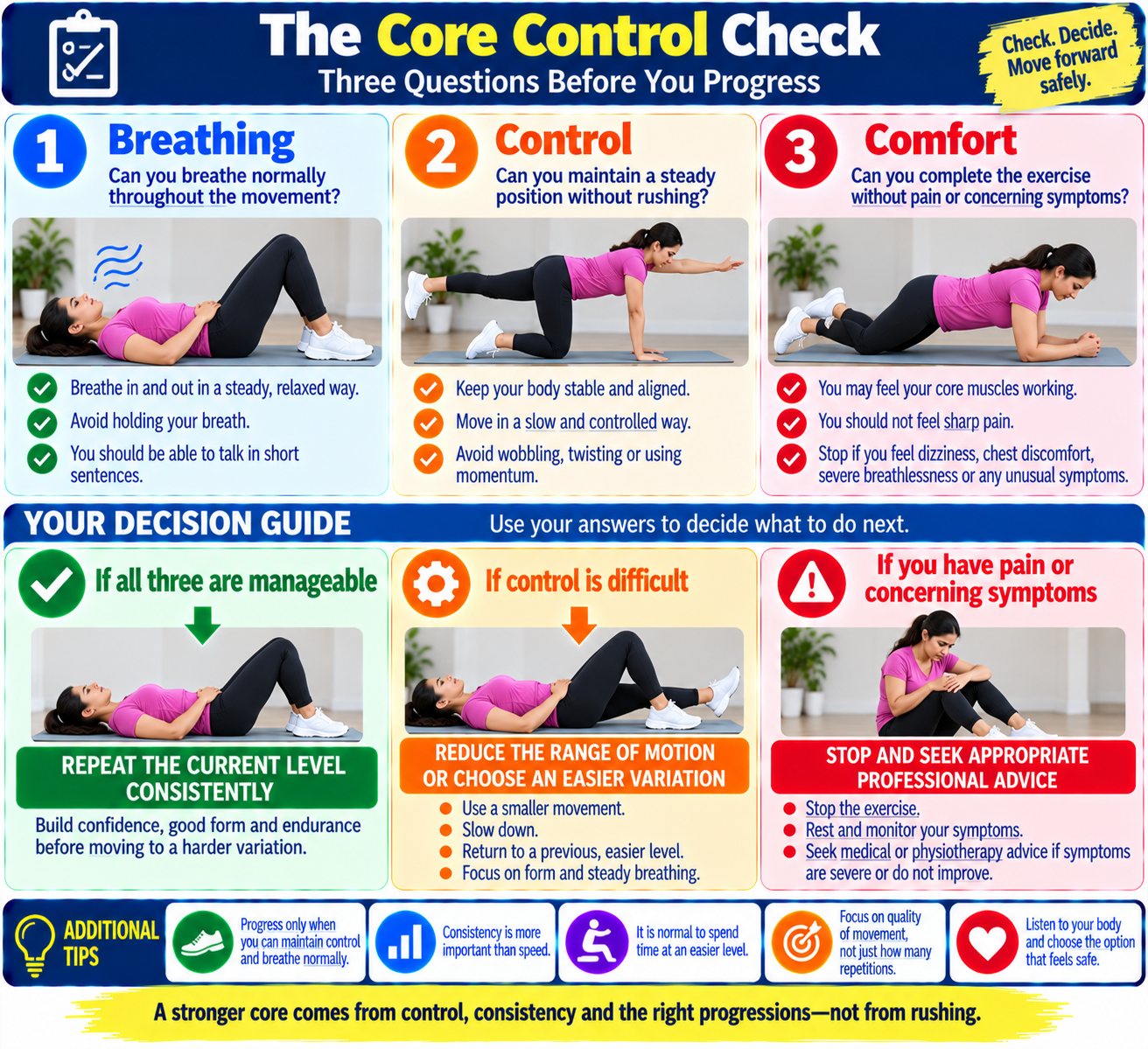
End the set when your movement becomes difficult to control, you begin holding your breath, or you feel that you need to rush to complete the repetitions.
A useful set is not one that leaves you exhausted. It is one that allows you to practice the movement with reasonable control and recover before the next exercise.
How Often Should Beginners Train Their Core?
Start with two or three short sessions each week, leaving recovery time between sessions. You can adjust the frequency based on your fitness, schedule, and response to exercise.
The World Health Organization recommends that adults undertake regular physical activity and include muscle-strengthening activity involving major muscle groups on at least two days per week. Its guidance also encourages people to start with amounts they can manage and increase activity gradually. Read the WHO physical activity guidelines.
Core exercise is only one part of a balanced routine. Walking, other aerobic activity, and strength training for the rest of your body also matter.
Example weekly schedule
| Day | Activity |
|---|---|
| Monday | Beginner core routine |
| Tuesday | Comfortable walking or another preferred activity |
| Wednesday | Rest or gentle mobility |
| Thursday | Beginner core routine |
| Friday | Walking or general strength training |
| Saturday | Optional short core session if recovered |
| Sunday | Rest or light activity |
You do not have to follow this exact schedule. If two sessions per week fit your life better, begin there and focus on consistency.
A Four-Week Plan to Progress Without Rushing
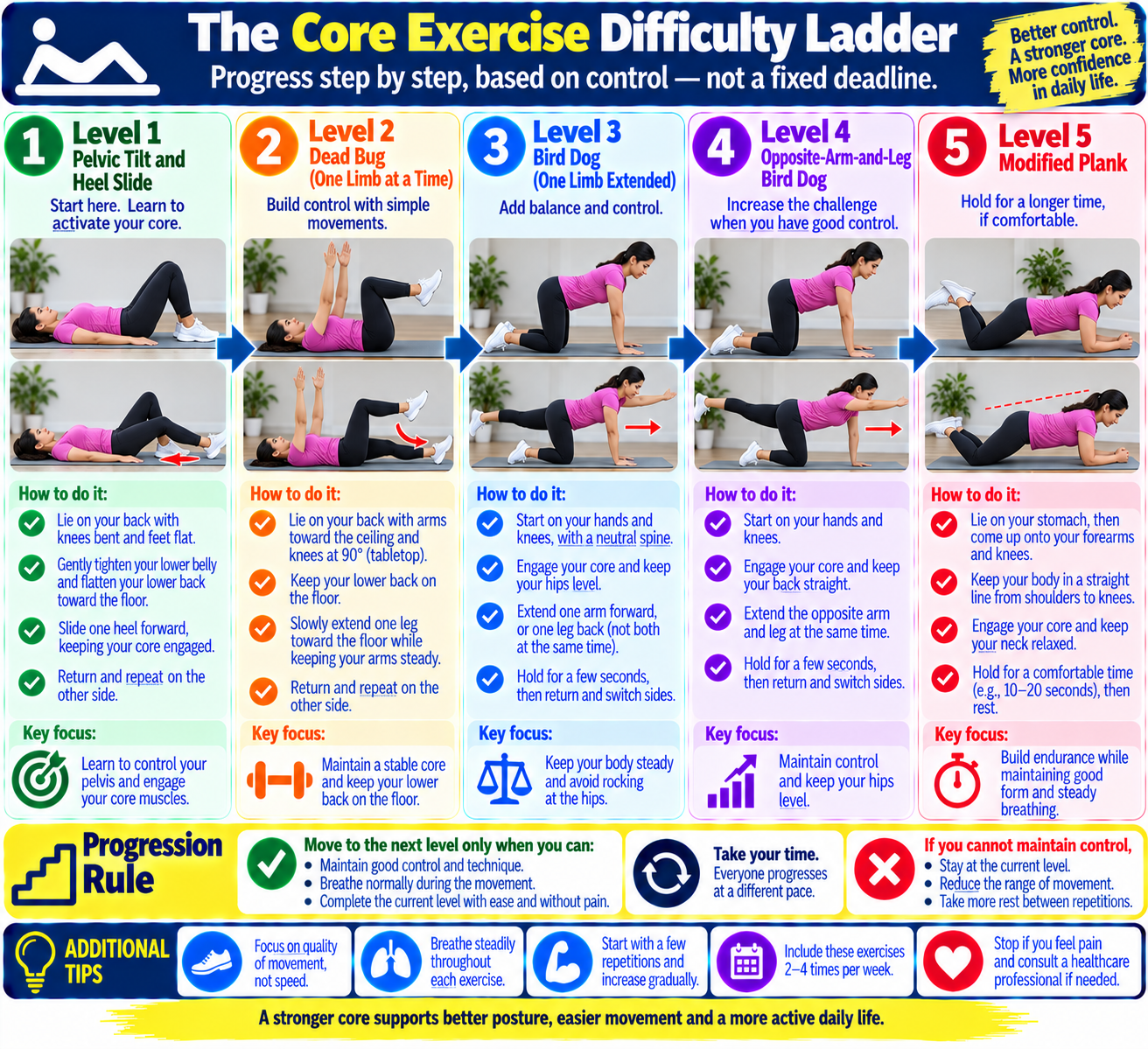
Progress does not mean making every exercise harder every week. It means choosing a challenge you can manage while preserving control and recovery.
| Week | Main goal | Suggested adjustment |
|---|---|---|
| Week 1 | Learn the movements. | Practise four exercises with short sets. |
| Week 2 | Improve control. | Repeat the same routine and refine technique. |
| Week 3 | Build tolerance. | Add a few repetitions to selected exercises if comfortable |
| Week 4 | Review progress. | Increase one variable or continue at the same level. |
Some beginners will need longer than four weeks before they are ready to progress. That is normal. You can repeat a week as many times as needed.
Before increasing the workload, ask yourself whether you can breathe normally, maintain a comfortable position, and recover between sets. If not, keep the current routine or reduce the difficulty.
Common Core Exercise Mistakes Beginners Should Avoid
Rushing through repetitions
Fast movements can make it harder to notice changes in body position. Slow down enough to maintain control, especially during heel slides, dead bugs, and bird dogs.
Holding your breath
Breath-holding can make a simple exercise feel unnecessarily difficult. Breathe normally throughout the movement, exhaling during the more demanding part if that feels natural.
Trying to flatten the back during every exercise
Different exercises require different body positions. During a pelvic tilt, gently moving the lower back toward the floor is part of the exercise. During a bridge or bird dog, forcing the back into that position may not be appropriate. Follow the instructions for each movement rather than applying one rule to every exercise.
Choosing a plank that is too difficult
A long hold is not better if your hips sag or you cannot breathe comfortably. Shorten the hold or return to a modified version.
Training the abdominal muscles but ignoring the rest of the body
A balanced routine includes trunk-control exercises, hip movements, and general strength training. Core strength is only one part of physical fitness.
Expecting pain relief or visible abs in a fixed time
Progress varies from person to person. Some people notice better movement control before they see visible changes. Core exercise can be part of a plan for some types of back pain, but persistent symptoms need appropriate assessment.
Practical Tips to Make Home Core Training Easier
Use a movement-quality check
After each set, ask yourself three questions: Did I breathe normally? Did I maintain control? Could I complete another repetition without changing my technique? These questions can help you decide whether to maintain or reduce the difficulty.
Choose the easiest version that still challenges you.
A heel slide may be more suitable than a dead bug at first. A short modified plank may be more useful than struggling through a full plank. Choosing an easier variation is not failure; it allows you to practice the skill required for later progressions.
Pair your workout with an existing habit.
You might schedule a short core session after your morning routine or before a regular walk. Linking exercise to an existing habit can make it easier to remember without needing an elaborate fitness plan.
Keep a simple record.
Write down which exercises you completed, how many repetitions you performed, and whether the movements felt controlled. This can help you notice progress without relying on body weight or daily comparisons.
Do not treat everyday posture as a constant correction task.
It is useful to vary positions and take movement breaks, especially if you sit for long periods. However, no single posture is perfect for every person all day. Comfortable movement and regular changes in position are more practical goals than trying to hold your body rigidly upright at all times.
Can Core Exercises Help With Back Pain?
Core exercises are used in some rehabilitation programs, and research suggests they may help certain adults with chronic nonspecific low-back pain. The 2022 systematic review of core-stability exercises found improvements in pain and function across five moderate-quality studies. However, back pain has many possible causes, and the right approach depends on the individual. Review the evidence on core-stability exercises for nonspecific low-back pain.
If you have ongoing back pain, a history of spinal injury, osteoporosis, or symptoms that worsen during exercise, do not assume that a generic online routine is appropriate for you. A healthcare professional or physiotherapist can help determine which movements are suitable.
Seek urgent medical assessment for severe or rapidly worsening symptoms, especially new leg weakness, numbness around the groin or saddle area, or new loss of bladder or bowel control.
Frequently Asked Questions
1. Can beginners build core strength at home without equipment?
Yes. Exercises such as pelvic tilts, heel slides, dead bugs, bird dogs, modified planks, and glute bridges use body weight and can be adjusted to different starting abilities. Begin with a few movements and progress gradually.
2. How long should a beginner core workout last?
A short session of around 10–15 minutes may be enough to start. The appropriate duration depends on your fitness and the number of exercises you can complete comfortably. You can gradually increase the session as your capacity improves.
3. Should I train my core every day?
Daily core training is not necessary for most beginners. Two or three short sessions per week can be a practical starting point, with recovery between sessions. Adjust according to your abilities and overall training plan.
4. Which core exercise is easiest for beginners?
Standing marches and gentle pelvic tilts are common starting options. The easiest exercise for you depends on your balance, mobility, comfort, and physical abilities.
5. Do core exercises burn belly fat?
Core exercises strengthen muscles, but they do not selectively remove fat from the abdomen. Changes in body fat depend on broader factors such as overall activity, eating habits, genetics, and energy balance.
6. Can I do core exercises if I have back pain?
Some core exercises may be appropriate for certain people with back pain, but not every movement suits every condition. If your pain is persistent, worsening, or related to a diagnosed spinal condition, seek individualized advice before following a generic routine.
7. Do I need an exercise mat?
No. Many movements can be performed without special equipment. However, a mat or comfortable surface may make floor exercises more comfortable, particularly for your knees, elbows, and back.
8. How soon will I notice results?
The timing varies. You may notice improved coordination or greater control before you see visible muscle changes. Consistent practice and gradual progression are more useful than expecting a specific result within a fixed number of days.
Conclusion
The best beginner core exercises at home without equipment are the ones you can perform comfortably, control consistently, and adapt as you become stronger. You can begin with standing marches, pelvic tilts, heel slides, bird dogs, and glute bridges before adding more demanding variations.
Keep your first sessions short, breathe normally, and stop when technique begins to deteriorate. As the routine becomes easier, increase repetitions or holding time gradually instead of changing everything at once.
Research supports core training as one way to develop trunk strength and balance, and it may help some people with chronic nonspecific low-back pain. It is not a guaranteed treatment or a replacement for individualized medical care.
You do not need a gym or a perfect workout plan to get started. A small amount of regular, well-controlled practice can help you build a foundation for a broader fitness routine.
Author Note
Author: RVLNSV PRASAD
This article provides general educational information about beginner core exercises and home fitness. Research links are included so readers can review the evidence behind relevant recommendations. Any personal training experience or individual success story should be included only when it reflects genuine, verifiable experience.
Medical Disclaimer
This article is for general informational purposes and is not a substitute for medical advice, diagnosis, or treatment. Exercise suitability varies according to health status, symptoms, medications, and physical abilities. Consult a qualified healthcare professional if you have persistent pain, a recent injury, osteoporosis, or another condition that may affect exercise.
Fitness Disclaimer
Exercise carries some risk, even when performed at home without equipment. Use a clear area, select exercises appropriate for your abilities, and stop if you experience pain or concerning symptoms. The workout examples are general starting suggestions, not individualized exercise prescriptions.
Sources
- Mayo Clinic — Exercises to Improve Your Core Strength
- Systematic Review of Core-Stability Exercises for Nonspecific Low-Back Pain — PubMed, 2022
- Effects of Core Training on Dynamic Balance Stability: A Systematic Review and Meta-Analysis, 2022
- Effects of Different Core-Training Types on Chronic Nonspecific Low-Back Pain: Systematic Review and Meta-Analysis, 2025
- World Health Organization — Guidelines on Physical Activity and Sedentary Behaviour
- Similar posts
- 6 Home Exercises for Overall Fitness and Flexibility: A Comprehensive Guide
- Full Abs Workout at Home: Daily Routine to See Results in 30 Days
- HIIT Workouts for Beginners: How to Start and See Results Fast
- 15 Pilates Exercises for Beginners: A Gentle Start to Core Strength and Flexibility
- 7 Strength Training Exercises for Women Over 40: A Comprehensive Guide
- Category
- 6 12 25 Workouts: The Muscle-Building Secret Behind This Brutal Hypertrophy Method
- 12 Plyometric Workouts for Speed: Explosive Exercises to Boost Performance
- Rucking for Beginners: Gear, Tips, and Training Plans
- HIIT vs. LISS: Choosing the Right Workout for Greatest Fat Burn
Post Views: 2,365









[…] 10 Best Core Exercises for Beginners at Home: Build a Stronger Core Without Equipment […]
[…] 10 Best Core Exercises for Beginners at Home: Build a Stronger Core Without Equipment […]
[…] 10 Best Core Exercises for Beginners at Home: Build a Stronger Core Without Equipment […]